
The New Zealand vs India 4th T20I is set to take place at Eden Park in Auckland on Friday, 30 October 2026. India have already secured the five-match series by winning the first three games. The hosts now need a response, while India will aim to keep their winning run going and move one step closer to a clean sweep.
This preview covers the match date and time, venue, series results, likely team combinations, key players, pitch factors, head-to-head numbers, and a cautious match prediction. The fixture is still upcoming as of 29 October, so the toss, final playing XIs, and match result are not yet known.
New Zealand vs India 4th T20I 2026: Match Details
| Match | New Zealand vs India, 4th T20I |
|---|---|
| Tour | India tour of New Zealand 2026 |
| Date | Friday, 30 October 2026 |
| Venue | Eden Park, Auckland, New Zealand |
| Start time | 8:00 PM local time / 12:30 PM IST / 7:00 AM GMT |
| Series score before match | India lead 3–0 |
| Match status | Upcoming; toss and result pending |
India Lead the T20I Series 3–0
India have won each of the opening three matches, securing a 3–0 lead in the five-match series. The first two games were close, with India winning by four wickets each. The third match was more one-sided: India chased 199 in only 13.2 overs and won by six wickets.
Results from the First Three T20Is
| Match | New Zealand | India | Result |
|---|---|---|---|
| 1st T20I, Christchurch | 225/4 | 230/6 (19.4 overs) | India won by 4 wickets |
| 2nd T20I, Christchurch | 180/5 | 181/6 (19.5 overs) | India won by 4 wickets |
| 3rd T20I, Wellington | 198/3 | 199/4 (13.2 overs) | India won by 6 wickets |
What the First Three Results Tell Us
New Zealand have shown they can score quickly. In the third match, Daryl Mitchell made an unbeaten 89 from 52 balls, Finn Allen scored 40, and Bevon Jacobs finished unbeaten on 39. However, New Zealand have struggled to contain India’s response and take wickets at key moments.
India’s third-match chase was powered by Abhishek Sharma, who scored 113 from 50 balls with 13 sixes, and Vaibhav Sooryavanshi, who made 45 from 19 deliveries. Their 133-run opening stand came from just 43 balls. India reached the target with 40 balls remaining, showing how quickly a T20 match can change when the top order gets going.
For the fourth match, New Zealand need early breakthroughs, tighter middle overs, and better execution at the death. India will want to keep their aggressive approach while avoiding a drop in focus now that the series is already decided.
Why the Fourth Match Still Matters
Although India have already won the series, the fourth T20I is not a dead rubber. New Zealand can restore confidence before the final game and test combinations ahead of the ODI leg. India, meanwhile, can assess their bench strength, keep their standards high, and try to finish the series without giving the hosts momentum.
A useful preview should focus on confirmed fixtures, player availability, performance trends, and conditions rather than treating any prediction as a certainty. Readers can also explore general sports-entertainment coverage at cricbet99sports.com. This link is not a match source and does not affect the cricket assessment.
New Zealand Team News: Two Fast-Bowling Absences
New Zealand have a significant selection problem before the Auckland game. Lockie Ferguson and Matt Henry have been ruled out for the remainder of the T20I series. Ferguson suffered a calf injury during the second match, while Henry injured his quadriceps. Matt Fisher has been called into the squad as a replacement.
Losing two experienced quicks puts more pressure on the remaining attack. Adam Milne can offer pace, while Jacob Duffy, Blair Tickner and the other available seamers will need to share responsibility. New Zealand may also lean more heavily on captain Mitchell Santner and spin options if the pitch allows them to slow India’s scoring.
Selection can still change after the toss, and a squad member’s presence does not guarantee a place in the final eleven. New Zealand need a balanced attack that can defend the short boundaries without losing control of line and length.
India Team News and Possible Combination
India’s squad is built around aggressive top-order batting, flexible all-rounders, and several bowling options. Shreyas Iyer is the captain, while Abhishek Sharma, Sanju Samson, Tilak Varma and Vaibhav Sooryavanshi give the side different ways to attack. Axar Patel, Shivam Dube and Nitish Kumar Reddy provide balance, depending on the final combination.
Bhuvneshwar Kumar’s return to the T20I group is one of the tour’s notable storylines. His ability to move the new ball could be valuable in New Zealand conditions, especially if there is early swing. Arshdeep Singh offers a left-arm angle, while spin options such as Axar Patel, Kuldeep Yadav and Varun Chakaravarthy give India ways to change pace through the innings.
India may keep the top order attacking while using all-rounders to maintain depth. Check the confirmed XI after the toss.
Key Players to Watch in the New Zealand vs India 4th T20I
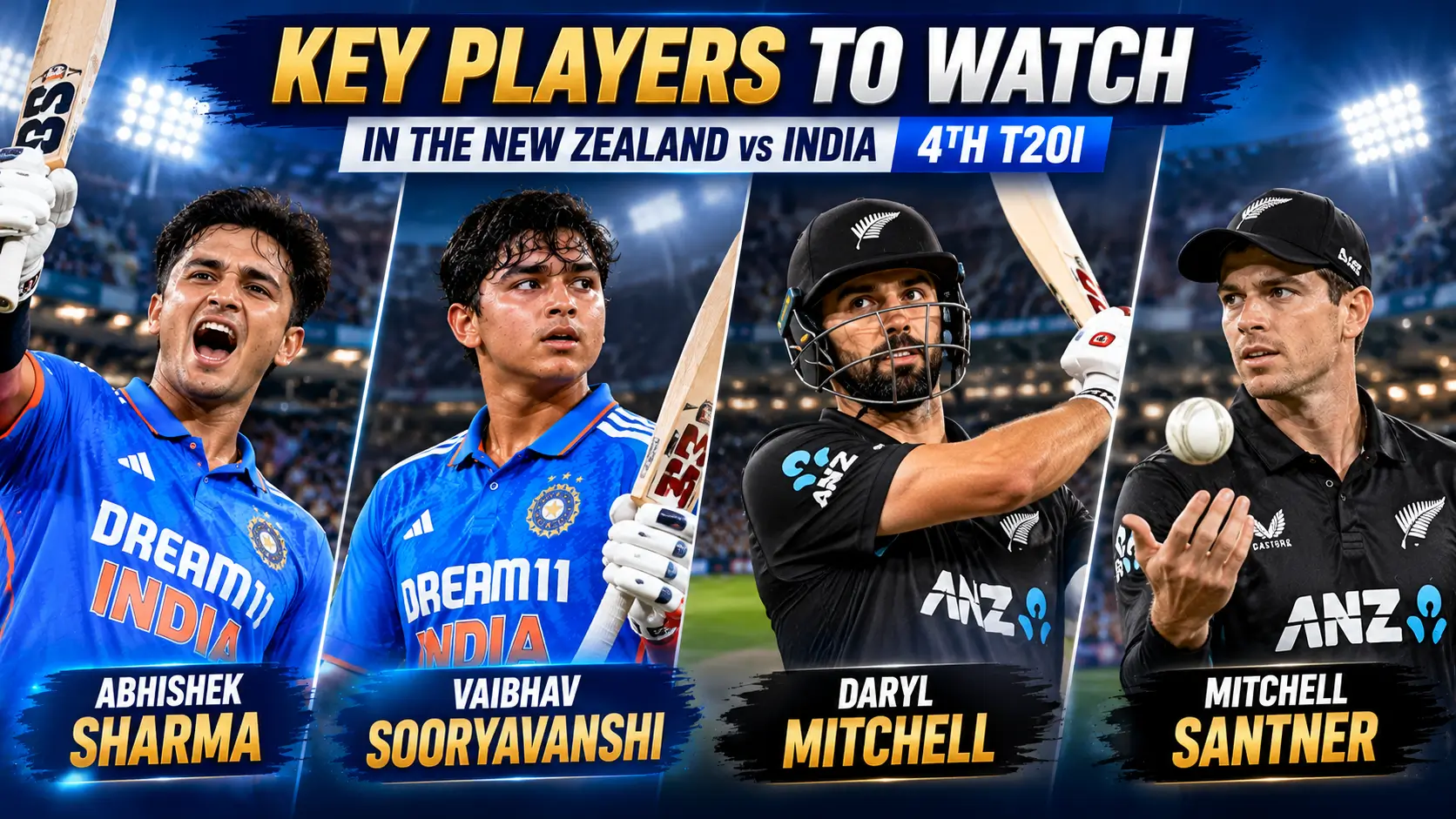
Abhishek Sharma: India’s Momentum Setter
Abhishek arrives in Auckland after a remarkable 113-run innings in Wellington. His value is not only the number of boundaries he hits; he can put the opposition under pressure before the field spreads. If he starts quickly again, New Zealand may have to alter their lengths and bowling plans early.
Vaibhav Sooryavanshi: Fearless at the Top
Sooryavanshi’s 45 off 19 balls in the third T20I showed how a fast start can support an aggressive chase. His role may depend on India’s chosen opening combination, but his ability to score quickly makes him a player to watch if selected.
Daryl Mitchell: New Zealand’s Reliable Batter
Mitchell’s unbeaten 89 in Wellington was a major positive for New Zealand. He can build an innings while still finding boundaries, and the hosts will need another composed performance from their middle order. His partnership with Finn Allen or Glenn Phillips could determine whether New Zealand reach a competitive total.
Mitchell Santner: Captain and Spin Option
Santner faces a tactical challenge as captain. He needs to find ways to break partnerships without allowing India to target the shorter side. His left-arm spin can help manage the middle overs, but his field placements and bowling changes may be just as important as his own figures.
Eden Park Pitch and Conditions
Eden Park is a major Auckland venue known for hosting both cricket and rugby. Its compact boundary shape can reward clean hitting, so batters who use the pace of the ball may find scoring opportunities. At the same time, the ground’s dimensions can create tactical choices for bowlers: they must know which side to protect and avoid predictable lengths.
Venue records suggest that T20 cricket at Eden Park can produce lively scoring, but averages are only guides. The surface prepared for this match, weather, dew, and the quality of bowling will affect the actual conditions. A high-scoring venue does not guarantee a big total, just as a modest first innings does not automatically make a chase easy.
The toss may influence the decision, particularly if captains expect the ball to come onto the bat better later. Still, teams should make their choice after inspecting the pitch and considering the forecast. The most useful prediction is based on the conditions visible on match day, not on venue reputation alone.
India vs New Zealand T20I Stats and Score Comparison
The first three matches show India’s ability to finish chases at different speeds. The first two required almost the full 20 overs, while the third was completed in just 13.2 overs. The chart below compares the teams’ innings totals across those matches. It is a simple score comparison, not a forecast for Auckland.
Team totals by match (runs)
Scale: 250 runs = 100% bar width. Values are the final team totals from the first three matches.
| Series metric after 3 matches | Figure |
|---|---|
| India’s series lead | 3–0 |
| India wins by wickets | 4, 4 and 6 |
| Highest New Zealand total so far | 225/4 |
| Highest individual score in the first 3 games highlighted here | Abhishek Sharma 113 |
| India’s quickest chase in this series | 199 in 13.2 overs |
What New Zealand Must Improve
First, New Zealand need wickets in the powerplay. India’s opening batters have shown that even a target close to 200 can become manageable if the first six overs go their way. Early wickets would force India’s middle order to rebuild and reduce the freedom available to the finishers.
Second, the hosts need a more disciplined death-overs plan. Full tosses and predictable pace can disappear over Eden Park’s boundaries. Bowlers should mix yorkers, slower balls and hard lengths, but each variation must be executed accurately. A plan is only useful if the bowler can land it under pressure.
Third, New Zealand’s batters must turn starts into a total that challenges India. The top order has supplied runs, but partnerships need to continue through the middle overs. A strong finish from Mitchell, Phillips, Jacobs or another selected batter could give the bowlers a more realistic chance.
What India Should Focus On
India should avoid treating the match as a formality. Their batting has been outstanding, but New Zealand can still make the contest close if India lose quick wickets. A balanced approach would keep the intent high while ensuring the side does not hand the hosts easy opportunities through risky shots.
With the series already secured, India may also consider how to manage workloads and assess combinations. Any changes should preserve balance between batting depth and bowling options. The bowling group will want to improve its control after conceding 198 for three in Wellington, even though the target was chased down rapidly.
Head-to-Head: India Have the Historical Edge
The ICC match centre’s head-to-head summary lists India with 22 wins and New Zealand with 11 wins, alongside three tied matches in the overall comparison shown there. These numbers point to an Indian advantage, but past records do not decide a new match. Conditions, selection, injuries and execution on the day remain decisive.
The latest series results also favour India strongly. New Zealand have struggled to contain India’s batting, while India have repeatedly found a way to complete the chase. The hosts will need a sharper performance in both innings to change that pattern in Auckland.
New Zealand vs India 4th T20I 2026 Prediction
India enter the fourth T20I as the stronger pick based on current form, a 3–0 lead, and their explosive third-match chase. Their top order is confident, and they have several bowling options to adjust to conditions. New Zealand’s home advantage and the energy of an Auckland crowd should help, but the injuries to Ferguson and Henry make the bowling task more difficult.
A reasonable pre-match expectation is another competitive score, with India favoured if they maintain their current batting tempo. New Zealand’s clearest route to victory is to take early wickets, keep India below their preferred scoring rate, and make their own top-order runs count. The toss and pitch report could shift the balance, so this remains a prediction rather than a guaranteed outcome.
For official match updates, final squads and the confirmed scorecard once the game begins, use the ICC match centre for New Zealand vs India, 4th T20I. Check the playing XIs after the toss before relying on any predicted team list.
Key Takeaways from New Zealand vs India 4th T20I 2026
- India lead the five-match T20I series 3–0 after three wins.
- The fourth T20I is scheduled for 30 October 2026 at Eden Park, Auckland.
- The match begins at 8:00 PM local time, 12:30 PM IST and 7:00 AM GMT.
- New Zealand will be without Lockie Ferguson and Matt Henry for the remaining T20Is; Matt Fisher has been called up.
- Abhishek Sharma, Vaibhav Sooryavanshi, Daryl Mitchell and Mitchell Santner are key players to watch.
- India are favoured on recent form, but the toss, pitch and final XIs can influence the contest.
Conclusion
The New Zealand vs India 4th T20I 2026 brings different pressures for the two sides. India have already won the series and will look to maintain their standards, while New Zealand need a strong response in front of their home supporters. The first three matches have delivered high totals and exciting batting, but Auckland could test the bowlers’ plans and the batters’ decision-making.
India start with the advantage because of their recent results and powerful top order. However, the game is not decided before the first ball. New Zealand can make it competitive by taking early wickets and finishing their innings well. The final outcome will depend on execution, selection and conditions at Eden Park.